Sintering is a key thermal process used to consolidate powder-based materials
into components with the density, strength and dimensional stability required by
the application. It plays a central role in powder metallurgy, but it is also used
with hardmetals, cermets, selected ceramics
and other advanced materials.
Before sintering, the material has already been shaped into a component, but its
particles are not yet fully bonded. At some point, that structure must become a
coherent part with the required physical and mechanical properties.
This is where sintering comes into play.
In simple terms, sintering uses heat to promote bonding between powder
particles and progressively transform a fragile compact into a solid component
with defined physical and mechanical properties.
When the process is carried out under vacuum, the furnace atmosphere becomes another
powerful process variable, helping to limit oxidation and control the environment
surrounding the material.
We will look at all of these factors throughout this series.
But first, we need to understand what actually happens during sintering—and why
this thermal step is so important in manufacturing.
What Is Sintering?
A green part is made of powder particles held in the required shape
by compaction, a binder or another forming method. It may resemble the finished
component, but its internal structure has yet to develop the strength and other
properties needed in use.
During sintering, the part follows a controlled heating and cooling cycle.
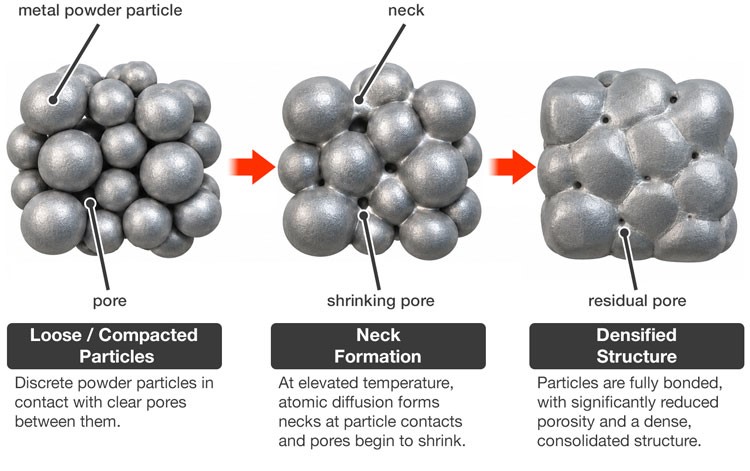
At elevated temperature, material moves across the contacts between neighboring
particles. Those contacts grow into metallurgical necks, while the pore structure
evolves.
Depending on the material and recipe, the part may become denser and stronger and
may shrink by a measurable amount. The aim is not always maximum density: some applications
need a defined level of residual porosity.
Shrinkage must be anticipated when the part and its tooling are designed.
A target dimension cannot be judged only from the green part's measurements: the
relevant question is how consistently each feature changes during the thermal cycle.
A part that meets its final density target can still be unusable if its critical
dimensions drift or distort. This is one reason dimensional checks belong alongside
tests of material properties.
This is why temperature alone cannot define a sintering recipe.
Powder composition and particle size, the density of the green part, heating rate,
holding time, atmosphere and cooling conditions all influence the outcome.
Two parts that appear identical before heating can behave differently if their internal
density differs. Uneven shrinkage can turn an upstream forming problem into a dimensional
defect after sintering.
Before going that far, however, it is useful to take one step back.
To understand where vacuum sintering really fits, we first need
to look at the wider powder metallurgy process—and at the different routes that
can bring a powder-based component to the sintering stage.
Where Vacuum Sintering Fits into Powder Metallurgy
Powder metallurgy is a family of manufacturing routes that start with powders.
The route used to shape the part determines what the furnace receives and what it
must do next.
- In conventional press-and-sinter production, a powder mix
is compacted in a die and then sintered.
- Metal injection molding, or MIM, blends fine metal
powder with a binder so that complex parts can be molded; the binder must then
be removed before the part reaches its final sintered state.
- Binder jetting also creates a green part that generally
requires debinding and sintering. Other additive processes,
such as laser powder bed fusion, consolidate powder by melting
it during printing and do not follow the same route.
- Hot isostatic pressing uses heat and high gas pressure
to densify material, so it should not be treated as another name for vacuum
sintering.
Consider what that means for the next operation.
A die-compacted part arrives with a density pattern shaped by the press and tooling.
A molded or binder-jetted part brings organic material that must be removed without
disrupting its geometry.
Both may enter a sintering furnace, but the risks to control are different.
Describing either case simply as 'heating powder' hides the decisions that determine
whether the cycle will work.
These distinctions matter when comparing benefits.
Near-net-shape production and reduced machining can come from the
chosen powder metallurgy route.
Vacuum does not create the geometry; it controls the environment during thermal
processing. Nor does every powder-based component need vacuum.
Whether it helps depends on the material and the properties the finished part must
achieve.
In the next section, we will follow that journey more closely—from loose powder
to a component ready for sintering—and see where debinding enters the process and
why it can become one of the most critical stages of the entire cycle.
From Powder to Sintered Part
The typical sequence is
- powder preparation,
- forming,
- binder removal when required,
- sintering, cooling and
- any final operations.
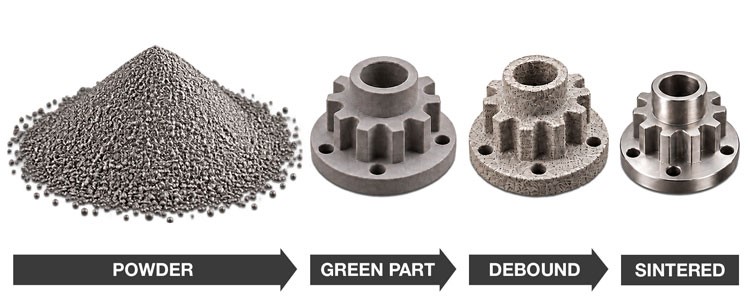
Each stage leaves a mark on the next.
Powder characteristics affect how consistently
a part can be formed; the green part's density influences shrinkage; residues left
by a binder can interfere with later processing.
Debinding deserves particular attention in MIM and other binder-based
routes.
The binder makes forming possible, but it must leave the part in a controlled way
without damaging the shape or leaving unwanted residue. It may be removed in a separate
unit or partly within a furnace that also performs sintering.
The choice affects handling, throughput and how decomposition products are managed.
A poorly controlled removal stage can create defects before the main sintering hold
even begins.
Combining debinding and sintering can reduce transfers of fragile parts
and may simplify the production sequence.
A separate debinding step can keep binder by-products away from the sintering
hot zone and free the sintering furnace for other loads. Neither arrangement
is inherently better.
The binder chemistry, cleanliness requirements, batch volume and time needed for
each stage should drive the decision.
This trade-off becomes especially important when a process moves from trial runs
to regular production.
After sintering, cooling conditions still matter. Some components then need sizing,
machining, surface finishing or further heat treatment.
The practical lesson is simple: a furnace cannot reliably correct every variation
introduced upstream. Before adjusting the thermal cycle to fix a recurring
defect, it is worth checking the powder, forming and debinding steps as well.
So where does vacuum enter this picture?
That is the next question to answer. Because vacuum is not simply an empty space
around the component—it is one of the variables that can determine how clean, controlled
and repeatable the sintering process will be.
Why Use Vacuum for Sintering?
At high temperature, the surfaces of powder particles can react with gases around
them.
By reducing the presence of oxygen and other unwanted species, vacuum processing
can limit oxidation and help maintain conditions suitable for particle
bonding.
This is especially relevant when surface chemistry affects the required properties
or appearance of the component.
Vacuum also gives the process engineer a way to manage the atmosphere, but it
does not make the chamber clean by itself.
Powder, tooling, binders, furnace components and residues from earlier cycles can
all introduce contamination. When debinding occurs in the same equipment, decomposition
products must be removed without redepositing on the load or fouling the hot zone
and pumping system. Cleanliness is a property of the whole process,
from incoming parts to gas flow and maintenance.
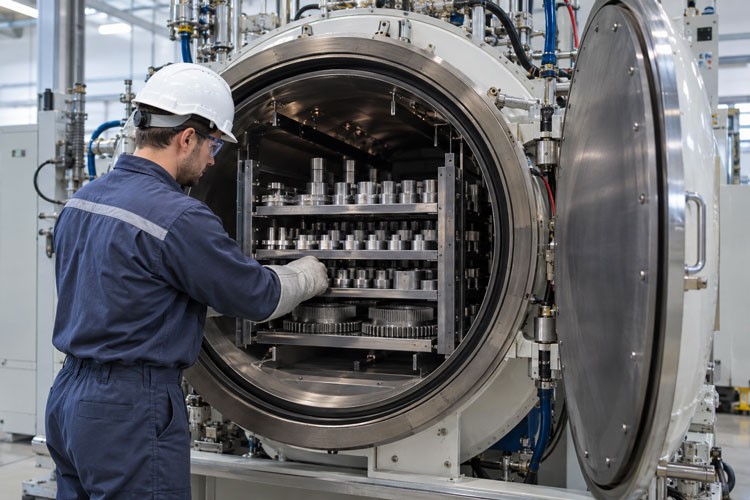
A vacuum sintering cycle need not remain at the lowest possible pressure
from start to finish.
The process may call for evacuation during one stage, a controlled partial
pressure during another, and a process gas when the material or binder
system requires it.
Gas composition and flow then matter alongside pressure.
A low ultimate-pressure figure on a specification sheet says little about whether
the furnace can hold the right atmosphere around the load at the right moment.
The pressure measured by an instrument is also only one view of the chamber.
A dense load, restricted gas path, leaks or substances released as the parts heat
can change what the components actually experience. For the process engineer, the
useful evidence is the pressure and atmosphere profile during a representative cycle,
together with results from parts in different load positions. Those observations
reveal more than a best-case empty-chamber value.
The real question is therefore not:
How low can the furnace pressure go?
but rather:
Can the furnace create and maintain the atmosphere required by the material
during every critical stage of the process?
Main Benefits of Vacuum Sintering
The most direct potential benefit of vacuum is control over surface reactions.
Limiting oxidation can help protect the material's surface condition
and reduce one source of variation during sintering.
The result still depends on the alloy, the starting powder and how effectively the
furnace removes or controls unwanted species.
Vacuum cannot compensate for contaminated feedstock or unsuitable handling.
Sintering itself develops the part's density, porosity and mechanical behavior.
A controlled vacuum or process atmosphere supports that transformation,
while temperature uniformity, time at temperature and green density determine whether
the intended result is reached throughout the batch. This is why the same nominal
recipe can produce different outcomes when load arrangement or furnace condition
changes.
Repeatability is another reason to control the atmosphere. In
production, the goal is to obtain the required result over many cycles, not only
in one successful trial.
Stable pressure and gas conditions help, but they must be matched by consistent
heating, cooling and loading practices.
Near-net-shape capability and material utilization, often listed
alongside these advantages, belong primarily to powder metallurgy as a whole; they
should not be credited to vacuum alone.
There is a practical limit to every benefit claim.
Cleaner surfaces, tighter variation or fewer rejected parts are possible outcomes,
but they depend on the actual material and process window. They should be verified
on representative components, including parts at the edge and center of the load.
Otherwise, an improvement seen in a small trial can disappear when batch size or
loading pattern changes.
Materials and Industrial Applications
Vacuum sintering can be relevant to
- MIM components,
- stainless steels,
- selected specialty alloys,
- hardmetals and
Some advanced ceramic systems also need tightly controlled thermal conditions,
although the suitable atmosphere depends on the material.
These are candidates for process evaluation, not a rule that every part in
those categories should be sintered under vacuum.
Sintered components are used across automotive, aerospace,
medical and industrial applications, among other
sectors. That breadth can be misleading when evaluating a specific furnace: an automotive
gear produced by conventional press-and-sinter, a MIM precision component and an
additively manufactured part may require very different thermal routes.
The industry identifies where a part will be used; composition, contamination
sensitivity, binder content, target properties and production volume determine the
process.
A useful application example therefore names the manufacturing route and material,
not just the sector. It also states the acceptance criteria: perhaps a density range,
dimensional tolerance, surface condition or mechanical property.
Without those details, a list of industries says little about whether vacuum is
necessary or what the furnace must be able to control.
And that brings us to the next question: what actually determines whether a vacuum-sintering
process will be successful and repeatable?
What Determines a Successful Vacuum Sintering Process?
A useful evaluation begins with the component, not the furnace datasheet.
Define the required density or porosity, dimensions, surface condition and material
properties. Then trace how the powder and forming method affect those targets. If
a binder is present, determine how it will be removed and where its by-products
will go.
Next, assess the conditions the complete load will experience.
Can the hot zone deliver sufficiently uniform temperature?
Can the system establish the pressure and gas composition needed
at each stage, and distribute any process gas through the load?
Does the loading arrangement allow heat and gas to reach the parts
consistently?
Capacity, cycle time, cleaning and maintenance needs also belong in the decision,
because a process that works for a trial batch may not be practical at production
scale.
Validation should follow the same logic.
Run a load that represents production rather than a handful of conveniently placed
samples. Record temperature, pressure and gas conditions during the cycle; then
compare dimensions, density and surface condition across load positions.
If results vary, examine the green parts and binder removal as well as the
furnace.
This evidence helps identify which variable needs attention before a process is
scaled or a new equipment specification is finalized.
Conclusion
These questions turn a general claim about vacuum performance into a process
specification that can be checked. They also show why equipment selection calls
for more than a maximum temperature and an ultimate-pressure value.
In the next article, we will look inside the furnace and examine how hot-zone
design, gas flow and loading influence the conditions the parts actually see.
If you are assessing a process or an equipment investment,
Gaeda can help examine furnace requirements
from an independent technical perspective, starting with the material and production
goals.
Did you enjoy this article?
Subscribe to our
WhatsApp channel and stay up to date with technical insights on vacuum furnaces,
industrial processes and advanced manufacturing technologies.
